


Andreas Vesalius and Human Anatomy
Find out about Andreas Vesalius and his approach to anatomy from anatomy lecturer, Dr Emma Saunders.
Andreas Vesalius
Born in Brussels in 1514, Andreas Vesalius studied medicine in Paris, later moving to the University of Padua in Italy, one of the oldest universities in the world. He then went on to teach surgery and anatomy here as a medical professor.
Dissection
Vesalius’s approach to anatomy went against what had been taught before him. He believed in scientific methods and the importance of observation. So, Vesalius tried out a new method of dissecting human bodies, which allowed him to identify all of our muscles, organs and bones. This led him to identify mistakes in Galen’s theories about the body, which had been respected for a long time. For example, Galen said the lower jaw had two bones (which is the case in some animals), but Vesalius proved it’s just one bone.
Despite the importance of what he discovered through dissection, what Vesalius was doing was against the law. In order to access human bodies, he would steal the corpses of criminals from graveyards and gallows. Not only was it illegal, but went against the teachings of the Church at a time when religion was central to society.
Once he had decided that human dissection was the most effective method for understanding our anatomy, Vesalius began encouraging his students at Padua University to do the same. Unlike professors that had gone before him, who taught anatomy through the ancient texts of Galen, Vesalius had his students carry out their own dissections. A judge even provided Vesalius with access to the bodies of executed criminals to make this possible.
On the Fabric of the Human Body, 1543
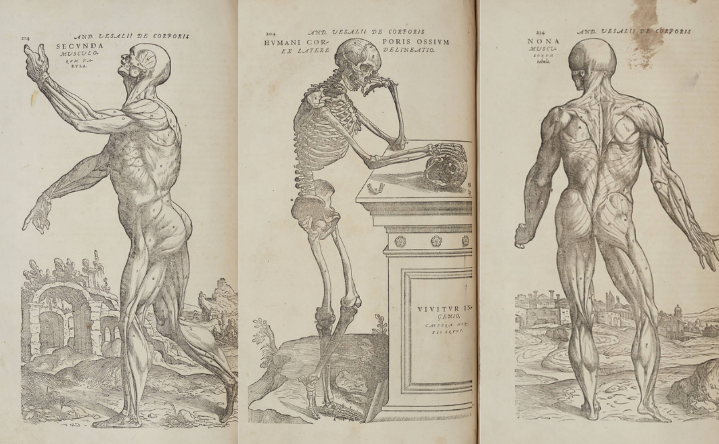
All of the knowledge Vesalius had gained through human dissection meant he could publish De humani corporis fabrica, otherwise known as On The Fabric of the Human Body or Fabrica for short, in 1543. Fabrica was completely revolutionary at the time. It completely changed our understanding of the human body.
During the Renaissance, artists were also studying human corpses but for a different reason: to help them draw human bodies more accurately. Vesalius worked with artists when creating Fabrica, which is made up of incredibly detailed illustrations of the human body alongside clear anatomical descriptions. The illustrations often show muscles, organs and bones, and some even feature the backdrop of the Italian countryside.
Fabrica’s Frontispiece
The title page of the book, known as the frontispiece, portrays Vesalius carrying out a public dissection for students and spectators and can be found in our Source Gallery. Select a number to find out more about the frontispiece of Vesalius’s The Fabric of the Human Body. How might it be a useful source for helping us understand medical developments in the Renaissance?
Impact
Vesalius had a significant impact on the medical world. However, many people were against Vesalius and his ideas because he went against society’s attitudes. His work posed a huge challenge to Galen who was supported by the Church and people believed it was wrong to dissect human bodies, so he had lots of critics.
Even though his discoveries didn’t immediately change how diseases were treated, Vesalius was an individual who changed the way we understand the human body. His scientific approach to observation and evidence paved the way for future medical discoveries, and is still relevant when new doctors learn about the human body today.
Quiz yourself!
Want to share feedback on this content? Get in touch or fill out the form.

