


Anaesthetics
Anaesthetics are medicines that are used in surgery to reduce pain by creating a loss of consciousness and/or feeling. Before anaesthetics, pain was a real problem for patients undergoing surgery. Surgeons had tried to find a solution for years.
Alcohol was an option to try and make surgery a bit easier, but it would increase a patient’s heartbeat and made it harder to keep bleeding under control. Opium was another option, but it wasn’t easy to get the dose right (which could have deadly consequences!). Nitrous oxide – otherwise known as laughing gas – was also introduced, but it was also hard to get the dose right.
In 1846, ether was used successfully as an anaesthetic by Robert Liston during a leg amputation. However, ether came with its own issues. It was not only flammable, but could cause patients to move around while sleeping or even wake up during surgery!
Did You Know?
Lots of surgeons believed that surgery should be painful for a patient as it would help them appreciate the work the surgeon was doing for them!
James Simpson
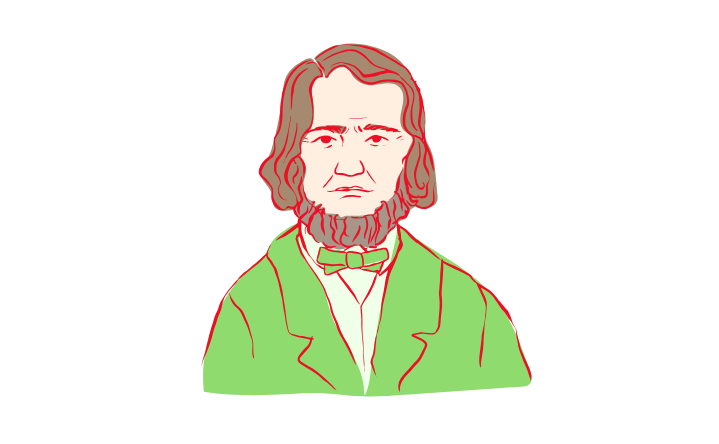
Born in Scotland in 1811, James Simpson was a Professor of Midwifery at the University of Edinburgh. Along with his impact on anaesthetics, Simpson was also known for developing forceps used during childbirth.
Chloroform
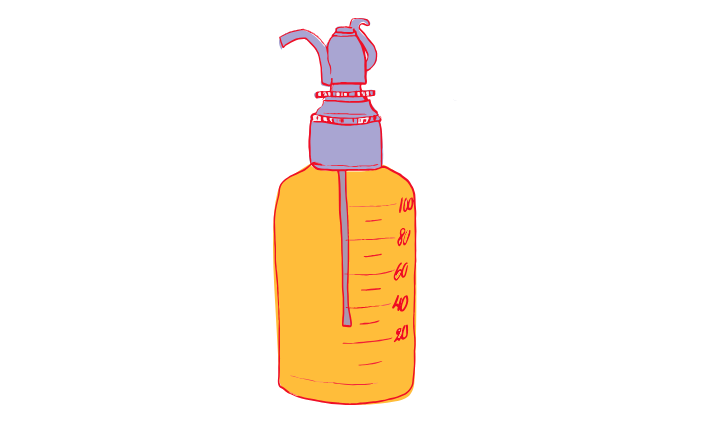
James Simpson discovered that a liquid known as chloroform could be used as an effective anaesthetic after experimenting with friends at home in 1847. You can see the brandy decanter Simpson used while trying out chloroform in our Source Gallery.
On discovering its effects, Simpson decided to use chloroform to reduce pain for women while giving birth and it began being used more widely for other kinds of surgery. As chloroform kept patients unconscious, it also meant surgeons could operate for longer and carry out more complex surgeries than what had been possible before. Typically, a surgeon would drop chloroform onto a cloth and hold it over a patient’s mouth and nose for them to inhale before surgery. This would cause the patient to become dizzy and unconscious.
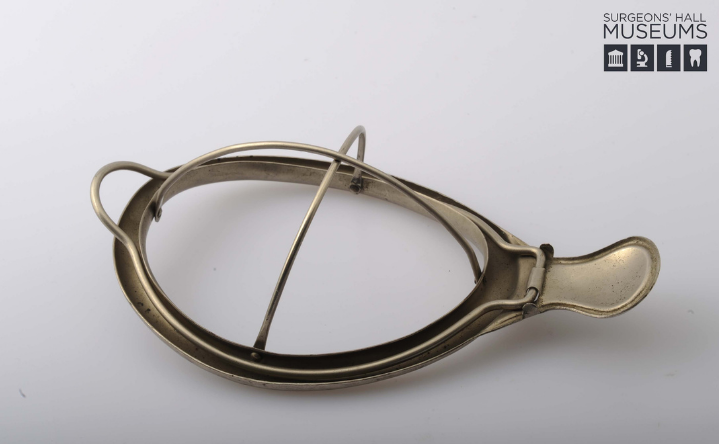
This chloroform mask held at Surgeons’ Hall Museum was invented in 1890 and used up until the 1950s. It consisted of a wire frame covered with several layers of gauze (gauze not pictured). A surgeon would place it over a patient’s mouth and nose and drop chloroform onto the gauze for them to inhale. You can view this mask up close in our Source Gallery.
Simpson’s Chloroform Case Studies
Select a case study from the menu to read Simpson’s observations taken from his Pamphlets on Chloroform, which can be found in Newcastle University’s Special Collections and Archives.
“A boy, four or five years old, with necrosis of one of the bones of the fore-arm. Could speak nothing but Gaelic. No means, consequently, of explaining to him what he was required to do. On holding a handkerchief, on which some Chloroform had been sprinkled, to his face, he became frightened, and wrestled to be away. He was held gently, however, by Dr Simpson, and obliged to inhale. After a few inspirations he ceased to cry or move, and fell into a sound snoring sleep. […] During this operation, and the subsequent examination of the wound by the finger, not the slightest evidence of the suffering of pain was given. He still slept on soundly, and was carried back to his ward in that state. Half an hour afterwards, he was found in bed, like a child newly awakened from a refreshing sleep, with a clear merry eye […].”
“A soldier who had an opening in the cheek […] was the next male to inhale. At first he showed some signs of moving his hands too freely; but soon also fell into a state of sleep and snoring. […] This patient had previously undergone two minor operations of a somewhat similar kind; both of them had proved unsuccessful and he bore them very ill – proving unusually unsteady, and complaining bitterly of severe pain. On the present occasion, he did not wince or moan in the slightest degree; and, on the return of consciousness, said that he had felt nothing.”
“A young man, of about twenty-two years of age, having necrosis of the first phalanx of the great toe, and ulceration of the integuments, the consequence of injury. The ulcerated surface was exceedingly tender to the touch – so much so, that he winced whenever the finger was brought near to it; and the slightest pressure made him cry out. After the removal of the dressings, which caused some pain and fretting, the inhalation was commenced, and the patient almost immediately became insensible and lay perfectly still, while the diseased mass was being removed by amputation of the toe through the middle of the second phalanx. […] The patient shortly after awoke, looked round him, and gratefully declared his entire and perfect freedom from all pain and uneasiness during the operation.”
“A young lady wished to have a tumour (encysted) dissected out from beneath the angle of the jaw. The Chloroform was used in a small quantity (about a drachm*), sprinkled upon a piece of operation sponge. In considerably less than a minute she was sound asleep, sitting easily in a chair, with her eyes shut, and with her ordinary expression of countenance. The tumour was extirpated, and a stitch inserted, without any pain having either been shown or felt.”
*A drachm (or dram) used to be used to be a way to measure the volume of a liquid. In today’s measurements, a drachm is around 3.5ml.
Challenges
Many people, both surgeons and patients, were against the use of chloroform for pain relief during surgery. Some people believed pain was sent by God and so it must be felt, and many surgeons relied on hearing a patient’s screams to know they were alive. Sometimes patients didn’t wake up after surgery if they had been administered too much chloroform.
However, in 1853 when giving birth to her eighth child, Queen Victoria was convinced by her doctor John Snow to use chloroform. Snow had created an inhaler that combined chloroform with water vapour so that surgeons could measure and control how much chloroform they gave to patients, rather than just pouring it onto a cloth to be held over a patient’s mouth and nose. Queen Victoria agreed it lessened the pain of giving birth, so the public then felt confident in using chloroform during surgery (because the Queen said so!).
Anaesthetics made surgery less painful for patients, but didn’t actually make surgery safer. Until surgeons were sure of the right dosage, anaesthetics could be seriously dangerous. Although anaesthetics allowed surgeons to attempt longer and more challenging operations, this created more risks and led to an increase in mortality rates from 1850 to 1870. This is known as the ‘black period’ of surgery. By the 1870s, lots of surgeons stopped using chloroform as a result.
Quiz yourself!
Want to share feedback on this content? Get in touch or fill out the form.

