


Welfare Reforms and the NHS
By the twentieth century, the Government no longer had a laissez-faire attitude to public health: they knew it was their responsibility to try to keep Britain healthy. Find out about how welfare reforms transformed healthcare in Britain from history lecturer, Dr Martin Farr.
Booth, Rowntree and Reeves
When the second Boer War broke out in 1899, thousands of volunteers were rejected as they were viewed as being unfit to serve in the army. As you can imagine, this was a big worry for Britain, so it was decided that an investigation must be carried out into the lives of everyday people to find out how they lived and what their health was like. Social reformer Charles Booth previously carried out social surveys in London, and his findings were published in Booth’s Life and Labour of the People in 1889. Through his research, Booth found that around 35% of London’s population were living in poverty.
Seebohm Rowntree, another social reformer, decided to do the same thing in his local area after hearing about Booth’s work, so carried out his own surveys in York. After interviewing over 46,000 people, Rowntree published his team’s research in 1901 in Poverty, A Study in Town Life. Through his research, Rowntree found that around half of working-class people in York were living in poverty at that time.
Much later in 1913, Maud Pember Reeves published her Round About a Pound A Week after carrying out a study of workers with jobs we’d expect to be well-paid (like police officers for example) and finding they weren’t able to live on their £1-a-week wage. Through her research, Reeves wanted to make people aware that lots of women went without food so that working men and children could eat, and that often wages were wasted away on alcohol.
Liberal Reforms 1906-1914
From 1906 to 1914, the Liberal Government passed several Acts to try and improve the quality of working-class people’s lives in Britain.
- The 1906 Workmen’s Compensation Act meant workers would be given compensation for any injuries they suffered when at work.
- The 1906 Education (Provisions of Meals) Act introduced free school meals for students.
- The 1907 Education (Administrative Provisions) Act introduced medical inspections to schools.
- The 1907 Matrimonial Causes Act meant divorced women were to receive maintenance payments.
- Also known as the Children’s Charter, the 1908 Children and Young Person’s Act introduced laws preventing the sale of fireworks, tobacco or alcohol to children.
- The 1908 Old-Age Pensions Act introduced state-funded pensions for those people over 70.
- The 1909 Housing and Town Planning Act banned back-to-back housing from being built.
- The 1911 National Insurance Act introduced National Health Insurance for workers.
1911 National Insurance Act
National Health Insurance was introduced by Lloyd George in 1911 through the National Insurance Act. George and the government set out this plan so that workers and their employers, as well as the government, could make weekly payments into the scheme in order for workers to access free healthcare and what was known as sickness benefit, which meant they could take paid time off work if they became too unwell. As men were the primary workers, this meant women, children and elderly people still didn’t have equal access to healthcare. It also didn’t cover every kind of job.
Despite its issues, this Act marked the beginning of change and a move towards what we know as the Welfare State. In 1913, a further National Insurance Act was passed. This time, unemployment insurance was covered, so workers who lost their job could claim unemployment benefit for a limited period of time until they found new work.
1919 Housing Act

The Housing Act of 1919 made a big difference to housing in Britain. It set the standard for housing, making sure that every new house that was built had the right amount of space, a proper water supply and working drains. Taxpayer money was used to fund building projects, and councils were ordered to provide new rented housing for people living in poverty in their area. This is what we now refer to as council housing. At the time, these houses were called “homes fit for heroes” because Lloyd George (who was now the Prime Minister) had promised to provide “homes fit for heroes” after the war when the British troops came home. Originally, 500,000 homes were promised but only half of these were actually built.
Following on from the 1919 Housing Act, other laws were passed throughout the twenties and thirties to try and improve the housing situation. However, money was tight between the World Wars so it wasn’t easy. In 1930, another Housing Act was passed which forced private landlords to sell their slum housing to the council, so they could build new houses in their place. By 1939, councils had built over one million houses for workers. Later on, when Clement Attlee was Prime Minister from 1945 to 1951, the Government built a further one million houses.
Beveridge Report
Social reformer, William Beveridge, published his Beveridge Report in 1942 that called for free healthcare for everybody in Britain, paid for through taxes. He strongly believed this would help overcome the five “giants” that were causing problems in Britain. These were:
- Want, because people lived in terrible poverty and didn’t have access to the basics
- Disease, because people didn’t have access to affordable healthcare
- Ignorance, because people didn’t have access to high quality education and information
- Squalor, because people lived in poor conditions and houses weren’t fit for purpose
- Idleness, because there weren’t enough employment opportunities, so people were out of work

Clement Attlee’s Labour Government
When the Labour Party came into power following their huge win at the 1945 General Election, Prime Minister Clement Attlee got busy straight away by putting the Beveridge Report into action and create a Welfare State. In order to do this, the Government had to pass a series of new Acts. Some examples include:
- The 1944 Education Act, which made primary and secondary education free.
- The 1946 National Insurance Act, which extended National Health Insurance to provide benefits for unemployed people, pregnant people, widows, mothers and children, and to provide pensions for those who retired.
- The 1946 National Health Service Act, which introduced the idea of a free National Health Service for everybody.
- The 1946 New Towns Act, which meant 14 new towns could be built.
- The 1946 and 1949 Housing Acts, which provided funding for local councils to build council houses and rebuild their towns and cities
Aneurin Bevan
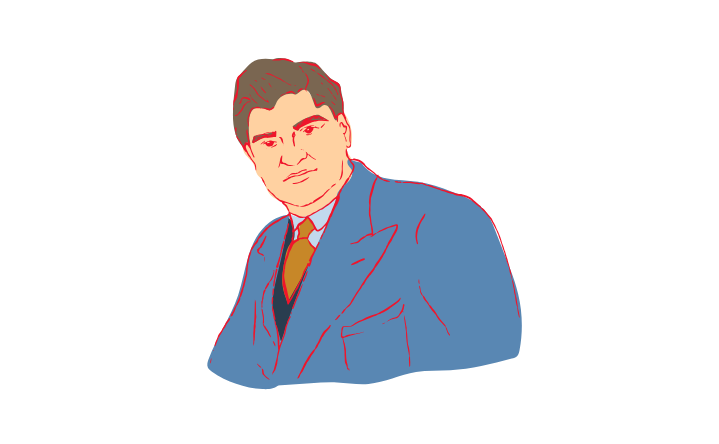
Born in Wales in 1897, Aneurin Bevan (who was known as Nye for short) was made Minister of Health under the Labour government by Clement Atlee following the 1945 General Election. It became his responsibility to oversee the birth of the NHS based on the recommendations made in the Beveridge Report. He is known as ‘the Father of the NHS”.
The Birth of the NHS
It was the 1946 National Health Service Act that led to the birth of what we now call the NHS. This Act meant that:
- Medical treatment became free for everybody.
- Medical care, from hospitals and pharmacies to opticians and dentists, were all brought together as one.
- Hospitals were to be nationalised, which meant they were run by the Ministry of Health.
- Salaries were provided to consultants working in hospitals.
- GPs, opticians and dentists set up their practices and were paid for how many patients were on their registers.
- Local councils were provided with funding to set up local health centres that could provide maternity care, vaccinations and health visits.
It wasn’t until two years later that all of these changes were in place. This was because Nye Bevan had many challengers, mainly from the Conservative Party and the British Medical Association (BMA). People were worried about the nationalisation of hospitals, there was anger about the cost of Bevan’s ideas, and the majority of the British Medical Association stated they would refuse to work with the NHS. As you can imagine, doctors were concerned they would lose out on money if healthcare became completely free. But Bevan managed to persuade people by allowing doctors to treat paying patients (what we know as private healthcare) alongside NHS patients who paid nothing. So the NHS was officially launched on July 5th 1948.
Despite its life-changing impact, the NHS isn’t without its problems. Healthcare didn’t stay completely free for very long – by 1952 costs were introduced for spectacles, prescriptions and dental care to help relieve some of the pressure on the NHS. Despite these fees, which are still in place today, the rest of NHS healthcare remains free, and is valued by most people for allowing them to seek medical help when they need it.
Government Intervention
Since the second half of the twentieth century, the government became much more involved in educating British people on matters relating to their health. Not everybody agrees it should be their role to do this, but the government has continued to pass laws, promote campaigns and share guidance to help people live healthy lives and prevent injury and illness.
Seatbelts
Wearing a seatbelt became a law in 1983 for people sitting in the front seat of a car, and back seat passengers in 1991. These laws were introduced to prevent deaths from car accidents, and have proved successful. At the time, people weren’t too happy about this idea, but seatbelts have saved countless lives on the roads.
Anti-smoking campaigns
Smoking used to be extremely popular in Britain, and was often seen as something that would make you look cool and glamorous! Little did people know the harmful tobacco in cigarettes was causing people to develop lung cancer. When scientists first tried to suggest this to the government, they didn’t listen. Now, everybody knows the dangers of smoking. Cigarette packaging displays horrifying images of what can happen to you if you smoke, the NHS supports people in quitting smoking, and smoking isn’t allowed indoors in public spaces.
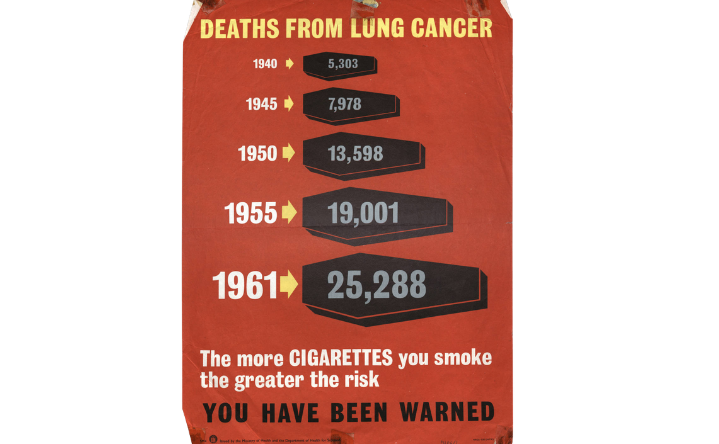
This poster issued by the Ministry of Health and Department of Health for Scotland warns people of the health risks of smoking by displaying how many people died of lung cancer in certain years. It’s quite a shocking poster with a large warning message and images of coffins. What can it tell us about public health in the twentieth century?
Alcohol advice
Deaths associated with alcohol misuse increased throughout the 2000s, so the Government stepped in to try and prevent this. The Scottish government (2018) and Welsh government (2020) agreed on a minimum unit price for alcohol, although there isn’t a set minimum unit price in England or Northern Ireland. However, the government created labels that can be found on all alcohol packaging and outline the recommended safe weekly limits for drinking alcohol.
Healthy living campaigns
The government promotes healthy living in lots of ways. You might have heard of the Eatwell Guide (which used to be called the Eatwell Plate). It breaks down what makes up a healthy diet, recommending how to achieve this through the food you eat – for example, by getting your 5-a-day through five portions of fruit and vegetables, or drinking 6-8 glasses of water a day. The government has also made sure that food packaging displays nutritional information so people can make healthier decisions. More recently, a ‘sugar tax’ on soft drinks was introduced in 2018, and the NHS’s Walking for Health campaign encourages people to take 10,000 steps a day. All of these measures are in place to try and prevent public health problems like diabetes and obesity.
Vaccination programmes
From cervical cancer and Covid-19 to meningitis and measles, vaccines are offered nationally for a range of illnesses to protect the public from catching them. Some vaccines are offered to everybody, and some are offered to specific people who might be vulnerable. In Britain, vaccines aren’t completely compulsory and people have the option to reject the offer for themselves or their children. Vaccination programmes have proven to be successful, reducing cases of illnesses if not wiping them out completely.
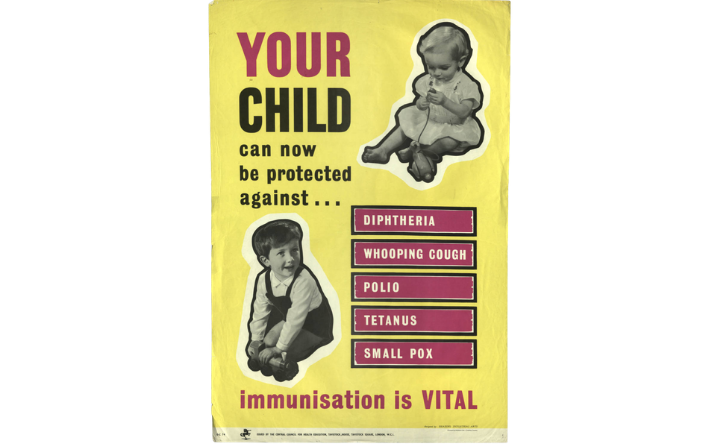
This poster issued by the Central Council for Health Education in the twentieth century advises parents that their children can be vaccinated against diphtheria, whooping cough, polio, tetanus and smallpox. At the bottom of the poster, it states “immunisation is VITAL”, showing just how urgently the government wanted children to be vaccinated against these illnesses. As a result of vaccination, smallpox was eradicated in 1980.
Covid-19
In March 2020, Britain went into lockdown in response to the Covid-19 pandemic. The public was ordered to stay in their home and stay 2 metres apart from others, businesses were asked to stay closed, and only people with essential jobs like healthcare were allowed to work. These people were known as key workers. Although this was a very challenging time, where children missed out on education and families missed special occasions with their loved ones, these rules were put in place to prevent people catching coronavirus and to protect those who were vulnerable and could die from it. Despite these efforts, over 200,000 people in Britain died with Covid-19 between March 2020 and May 2023.
Quiz yourself!
Want to share feedback on this content? Get in touch or fill out the form.

